Mandatory working time tracking in 2027
Make your Belgian company compliant with Odoo
From January 1, 2027, all Belgian employers will be required to record their employees' working hours. Most companies will simply tick the compliance box. Others will turn this data into real visibility over their projects and profitability.
Book a call
What the law requires and what is already in force
Through two rulings issued in 2019 and 2024, the Court of Justice of the European Union imposed on Member States a working time recording system that is objective, reliable and accessible for every worker.
In November 2025, the Belgian federal government confirmed the application of this obligation from January 1, 2027. The final law will be published in the Belgian Official Gazette during 2026.
Timeline :
- May 2019 : CJEU ruling C-55/18 — CCOO v. Deutsche Bank: obligation of an objective, reliable and accessible system for all workers.
- December 2024 : CJEU ruling C-531/23 — Loredas: the obligation is extended without exception, including to domestic employees.
- November 2025 : Belgian federal budget agreement: general recording obligation confirmed for all employers.
- January 1, 2027 : Entry into force. All Belgian employers must have a compliant system.
Working time tracking with Odoo: a solution configured and customized for your Belgian company
Odoo offers two complementary tools to record working time.
Eezee-it configures them according to your organization, so that every hour entered is useful beyond simple compliance.
Odoo Attendance : the direct answer to the 2027 obligation
Odoo Attendance is a complete digital time clock. It records the start time, end time and breaks of each employee : exactly what the law requires.
Tablet on site with badge or PIN, web interface at the office, mobile app for field or remote teams. Each employee clocks in from their work context, without a PC.
An employee forgets to clock out? The system does it automatically after a configurable delay. Data remains reliable — even on rush days.
Automatic calculation with configurable tolerances in both directions. Anomalies are reported in real time to managers. They see problems before closing.
The complete history of each employee is tracked, secured and exportable. In case of an inspection, you have the data in just a few clicks.
Clocked hours feed directly into payroll calculation in Odoo. No more manual exports between systems, no more risk of error at monthly closing.
Leave, sickness, time off in lieu, all in the same tool. Managers have a real-time view of their teams' availability.
Already using Timesheet in Odoo?
Eezee-it can configure the link between Attendance and Timesheet, each clocking automatically feeds the right project without any additional action from your teams.
This is what we set up at Desimone: operators clock in the workshop, time is automatically allocated to projects and the cost price is calculated in real time.
Odoo Timesheet : to go well beyond compliance
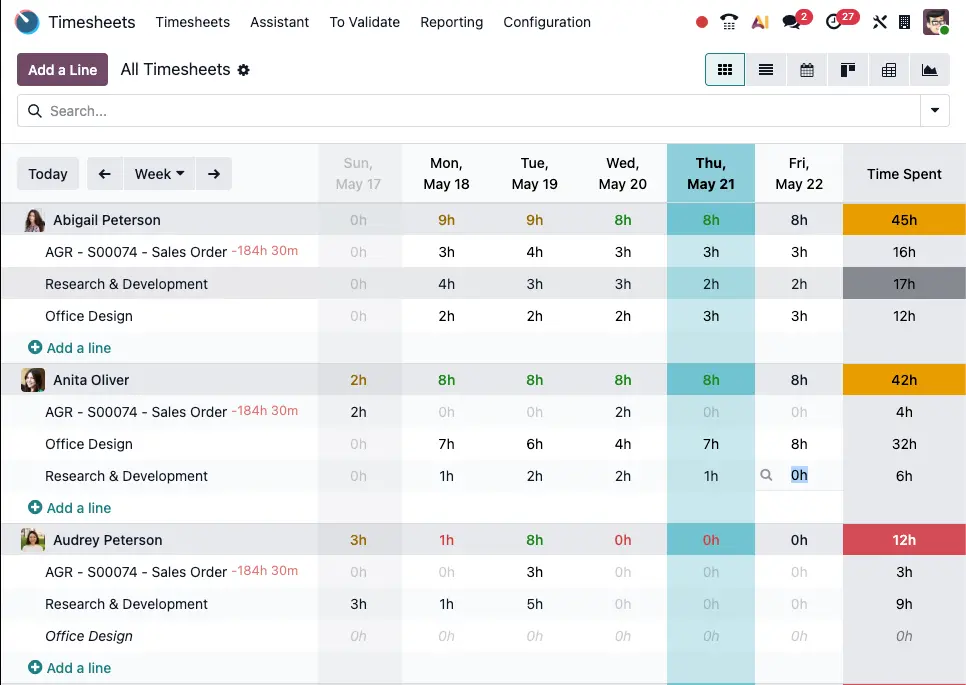
Where Attendance records presence, Timesheet allocates time by project, client and task. For service companies, consulting firms or any company that bills by time spent, it is the tool that turns hours into management data.
Integrated timer or manual entry,each hour is attached to a specific activity. From a computer, tablet or smartphone, wherever the employee is.
Validated hours directly generate invoice lines. You bill exactly what has been performed without re-entry, without forgetting, with a detailed supporting document for your client.
Planned hours vs actual hours, in real time. You identify the missions that exceed the budget before it impacts your margins and you adjust.
Visualize hours by team, project, client or period in a few clicks. The data is already there : no Excel exports, no manual consolidation.
For projects sold at a fixed price, you compare the budget consumed with the amount invoiced in real time. You see drift coming and you react in time.
Compare available hours with project commitments. You anticipate overloads and under-loads before they become problems.
Already using Attendance in Odoo?
Eezee-it can configure the reverse link between Timesheet and Attendance : each Timesheet entry automatically generates the corresponding Attendance record (start time, end time), without changing the habits of your teams.
Meet our expert !
An Eezee-it consultant analyzes with you your specific obligations, shows you concretely how Odoo adapts to your reality and tells you what is feasible and within what timeframe.

What you gain by choosing Odoo rather than a time clock
A time clock solves 2027 compliance. Odoo solves compliance and gives your organization a visibility it did not have.
One data source, four business outcomes
- Attendance → Payroll : your monthly HR closing in less time
Clocked hours automatically feed payroll calculation. No more Excel exports between systems, no more re-entries, fewer errors. Your HR team gets back time on each closing time it can spend on something else. - Attendance → HR : you see problems before they become crises
Leave, absences, time off in lieu, overtime all in a single tool. You detect overloads before they cause turnover or absenteeism. And you have the data to talk about it with your teams. - Timesheet → Billing : you stop leaving hours on the table
Entered hours directly generate invoice lines. No more forgotten hours at the end of the month, no more approximations, no more discussions with clients. You bill exactly what was done with a detailed supporting document to back it up. - Timesheet → Projects : real profitability, project by project
Planned hours vs actual hours, by project, by client, by consultant. You identify the missions that systematically exceed the budget and you adjust before it impacts your margins.

Data everywhere.
Payroll, projects, billing, HR reports : everything starts from the same source in Odoo.
No synchronization to manage, no diverging data.
That is the real difference with a standalone solution.
Three reasons to act before 2027
The obligation becomes formal in 2027 but some risks already apply today.
Reversal of the burden
of proof
In case of a dispute over overtime, it is up to you to prove that the hours were not worked. Without a recording system, this is almost impossible. Several Belgian courts already apply this without waiting for 2027.
Sanctions
already in force
The Social Penal Code already provides sanctions for variable working hours since July 2024. Sanctions for the general obligation will be defined during 2026 they will be significant.
3 to 6 months to properly deploy
Odoo
A well-executed deployment (configuration, payroll integration, team training) takes between 3 and 6 months. Waiting until mid-2026 means risking not being ready on time or rushing the implementation.

Desimone from workshop clocking to profitability steering
Desimone manufactures custom industrial robots for clients in various sectors. Their teams clock in from the workshop,Odoo automatically allocates time to each project and calculates the cost price in real time. A concrete case of the Attendance → Timesheet link in production.
"I do not care if someone comes at 8:15 or 8:30, but I do care to know how much time they took to do a specific task.
Odoo helps us a lot with time tracking and timesheeting. Everyone has access via a smartphone, a tablet, or a PC in the workshop to record what they do on the project. It is automatically linked to the project so that I can have a live view of the profitability of each and every project."
Axel Soyer CEO · Desimone, manufacturer of industrial robots

Frequently Asked Questions
Everything you need to know
Why choose Eezee?
Eezee helps companies implement, customize, and optimize Odoo to match their business processes. We deliver scalable ERP solutions designed for long-term growth.
Contact usNo. The law imposes an obligation of result, not of means. Any objective, reliable and accessible system is sufficient, physical time clock, mobile application, web interface or tablet kiosk. Odoo covers all these options.
Yes. The obligation applies to all Belgian employers without size exception from SMEs to large companies, both private and public sectors. Only self-employed workers without an employment contract are excluded.
Yes, Odoo Attendance records start, end and break times in an objective, reliable and accessible manner, which exactly meets the legal criteria. Odoo Timesheet is complementary for companies that want to go further on profitability and billing.
The question is legitimate. The law formally requires the recording of the start and end time, which Timesheet alone does not always guarantee. The final law (2026) will specify the terms for service companies. In the meantime, we analyze with you the most suitable configuration during the call.
The precise sanctions will be defined by legislation during 2026. The Social Criminal Code already provides for sanctions for variable schedules since July 2024. The immediate risk is the reversal of the burden of proof in case of a dispute, several Belgian courts already apply this.
Odoo has a native Payroll module that automatically synchronizes with Attendance. For third-party payroll software, connectors exist depending on the solutions. We analyze your existing environment during the discovery call.