ERP MIGRATION TO ODOO
What if Odoo were the logical next step for your ERP?
Microsoft Dynamics (Business Central, NAV), SAP or Sage reaching end of life? Move to a modern, integrated platform that covers everything your current system does, and grows with your business. We orchestrate your migration to Odoo, from audit to ongoing support.
We migrate from these ERPs to Odoo
THE SITUATION
You may recognise your situation here
If you are reading this page, several of these signals probably resonate with you.

Your ERP is reaching end of life
Your version is no longer supported, or will not be within a few months. The vendor pushes you toward its successor (S/4HANA, Dynamics 365, Business Central SaaS), with a long and costly project to follow.

Every update becomes a project
What took two days five years ago now takes two months, plus three months of stabilisation afterwards. Your external consultants have become indispensable.
The add-ons have stacked up
Each add-on has its own licence, support contract and update cycle. Combined, they often account for 25 to 35% of your real TCO.

Your tools no longer talk to each other
An ERP for finance, inventory and sometimes production, a CRM somewhere else, a website or shop on its own platform, sometimes payroll at an external provider. Between each tool, a connector to maintain and data to reconcile.

You know you need to move
Between migrating to the official successor and the status quo, a pragmatic option was missing. Today, Odoo covers 80% of the functionality of older Dynamics and SAP versions, at a cost and timeline on a completely different scale.
End-of-support dates shape your decisions: end of extended support for Dynamics NAV 2018 in January 2028, the extended support end of Business Central, end of standard maintenance for SAP ECC in December 2027 and migration to S/4HANA, not to mention the mandatory Peppol B2B requirement in Belgium since January 2026. For many organisations, the question of an obsolete ERP or end-of-life business software leads to a migration to Odoo, an integrated alternative to S/4HANA and Dynamics 365. We audit your version, your add-ons and your custom developments before any decision. To be confirmed on the official Microsoft Lifecycle and SAP Maintenance Strategy portals.
Why act in the coming months? Because a well-run project takes several months of preparation and execution. And because good integrators fill their schedules as the months pass. Organisations that decide now will have a better choice of partners and timelines than those that wait.
THE CHANGE
What an ERP migration to Odoo changes in practice
Odoo covers the vast majority of traditional ERP use cases, with one fundamental difference: a modular platform, natively integrated, built to evolve without rebuilding everything.

Everything in one system
CRM, sales, inventory, accounting, HR, e-commerce, e-invoicing: a single source of truth.

57 to 63% lower TCO
Over five years vs a Business Central with add-ons or an S/4HANA. Licences, add-ons and maintenance combined.
Add-ons: Continia, Tasklet, ForNav, Billtobox are all native in Odoo.
Maintenance: industrialised upgrades.
Over 3 years, the gap runs into hundreds of thousands of euros.

Open and connected
Hosting, AI, Microsoft 365, banks, marketplaces: Odoo integrates with your ecosystem instead of locking you in.
AI: OpenAI, Anthropic, Mistral, or self-hosted.
Microsoft 365: native integration.
Your data stays exportable, your code belongs to you.
Today, Odoo covers 80% of the functionality of older Dynamics and SAP versions, at a cost and timeline on a completely different scale.
Let’s look at your situationBefore — Traditional ERP
- ✕ Separate tools for CRM, ERP, e-commerce, HR
- ✕ Add-ons with per-licence fees (Continia, ForNav, Tasklet…)
- ✕ Upgrades that take months and break custom code
- ✕ Vendor lock-in on hosting, AI and data formats
- ✕ Rising TCO year after year
After — Odoo
- ✓ One platform covering CRM, ERP, e-commerce, HR natively
- ✓ One licence per user, all apps included
- ✓ Industrialised upgrades, no custom-code lockout
- ✓ Choice of hosting, AI provider and data format
- ✓ 57–63% lower TCO over five years
OUR ADDED VALUE
Migrating an ERP is more than configuring software
An ERP migration is not a technical question, it is a transformation. We handle the technical side well, like every good Odoo integrator. What makes the difference is everything around it.

We analyse and optimise your processes
A migration is the chance to rethink what has built up over the years: exceptions, workarounds, forgotten settings. We bring the perspective of 250 projects.

We drive change management
Adoption is prepared, not imposed. It is built by involving key users from the very first workshops and supporting teams over time.

We master data migration
This is the step that derails the most migrations. Our method structures the migration in several passes, validates at each stage, and reaches go-live with clean data.

We extend Odoo where your business requires it
We close the gap with our own modules, already developed and proven, designed to stay maintainable and compatible with version upgrades.
Discover our modules
We run the project
Clear governance, a schedule, a steering committee and an agile method. You always know where the project stands, who does what, and what comes next.

We secure your compliance
Peppol, VAT, and the standards specific to your industry (AFSCA, ISO, GxP) are built in from the design stage, not bolted on afterwards.
We know your starting point
Our experts come from both of your starting worlds. On the Microsoft side, one of them spent ten years selling, deploying and evolving Business Central, Dynamics NAV and Dynamics AX. On the SAP side, we know ECC from the inside. This dual culture concretely improves the quality of the audit and the migration.
THE TIMELINE
Why migrate your ERP now?
The traditional vendors have set a timeline that most organisations have not yet taken on board. Here are the dates that matter. More on the ERP deadlines
Why act in the coming months? Because a well-run project takes several months of preparation and execution. And because good integrators fill their schedules as the months pass. Organisations that decide now will have a better choice of partners and timelines than those that wait.
Dynamics AX 2012
End of extended support. No more security patches, no more regulatory compliance updates. If you are still on it today, you have been running with no coverage for three years.
Peppol B2B — Belgium
Structured e-invoicing between Belgian VAT-registered businesses is now in force. ERPs that do not handle it natively force you through a paid add-on, with per-invoice fees.
SAP ECC
End of standard maintenance in December. From 2028 to 2030, extended maintenance becomes chargeable, with a surcharge of around +2 to 4% per year. Then support stops. The official route, S/4HANA, is a long and costly project.
NAV 2018
End of extended support in January. For earlier versions, the deadline has already passed. For NAV 2018, the countdown has begun.
Dynamics GP
End announced. Microsoft has confirmed there will be no further releases.
Good integrators fill their schedules as the months pass. Organisations that decide now will have a better choice of partners and timelines.
YOUR STARTING POINT
The ERPs we replace with Odoo
We support migrations from the main ERPs on the market. Each environment has its specifics, so expand yours below.
This is the migration we carry out most often. The Navision, NAV, Business Central lineage is one of the largest installed ERP bases in Europe.
If you are on NAV 2018 or earlier, you are in the decision zone: NAV 2018 loses extended support in January 2028, and earlier versions are already out of support.
If you are on Business Central, support is not the urgency, but cost may be: with stacked add-ons and the Premium licence, the total often exceeds €200/user/month.
Our approach always starts with a full audit: versions, add-ons, custom developments, processes actually in use. Data migration is documented and industrialised.
Navision 5.0 NAV 2009 to 2018 BC on-prem & SaaS Continia Tasklet ForNav Billtobox
AX has been at the end of the road for a long time. AX 2012 lost extended support in January 2023. If you are still on it, you are running with no coverage, which can hold as long as nothing changes, but becomes critical at the slightest regulatory change.
Microsoft pushes toward Dynamics 365 Finance & Operations, a typically long and costly project. For many, the real question is not “AX to F&O” but “AX to what”. Odoo enters that comparison.
Our AX expertise comes from our ERP expert, a former Microsoft Dynamics partner: AX architecture, X++ developments, business modules. We know how to tell what must be reproduced exactly from what can be simplified along the way.
SAP ECC is the major global migration project of the moment: end of standard maintenance in December 2027, chargeable extension from 2028 to 2030 (a surcharge of around +2 to 4% per year), then the end of support.
The real hidden cost of a SAP migration is not the licence, it is the estate of custom ABAP developments (the Z-programs) built up over the years. We tackle it through real usage: we analyse two months of actual system use to rebuild only what genuinely serves a purpose, not the entire legacy. Many of these developments in fact map to native Odoo functions, and disappear along the way.
The official route is S/4HANA (Brownfield, Greenfield or Bluefield). In a company of this size, these projects start at a significant budget and several months of work.
The strategic question: stay in the SAP ecosystem at the cost of a massive overhaul, or use this window to rethink your application foundation? Odoo enters the comparison, particularly where SAP covered needs that are now largely served by more modern, integrated solutions.
SAP Business One is SAP for SMEs. It is still maintained, but many SMEs that deployed it 10 or 15 years ago are questioning whether to continue. Rarely over support: more often a total cost that drifts with industry add-ons, functional rigidity and a dated user experience.
Migrating to Odoo is technically simpler than from SAP ECC. The real issue is almost always change management: convincing long-time users that the transition brings a real gain.
Sage BOB is very common in Belgium; Sage 50 and 100 cover a similar segment. These are primarily accounting solutions, sometimes extended to sales management, but not true integrated ERPs.
When an organisation grows beyond a structured SME, Sage becomes too limited. Satellite tools are then added (a CRM, an inventory module, a project tool) and the stack ends up costing more than a true integrated ERP. This is typically where Odoo comes in: a simple migration and an immediate functional gain.
Depending on the state of your installation (version, technical debt, accumulated customisations), two paths are possible: a controlled upgrade to current Odoo, or a rebuild on a clean base with your data carried over.
The scoping audit determines the most relevant path, weighing maintenance cost, technical debt and the functional value worth preserving.
The Belgian and European market has a long tail of ERPs and business software that we regularly encounter. Exact is very common in Flanders. On the accounting and management side, we often see Winbooks, Venice, Popsy, Expert/M, Horus or Octopus. On the ERP side, Infor, Divalto, Cegid or Epicor. Silicon Master, Adfinity and other local vendors cover sector niches.
Whatever your starting point, the principle stays the same: we first look at what you have, how you really use it, and what to keep versus simplify.
Wondering if Odoo fits your situation?
We walk you through a structured conversation: your current setup, the scope that matters, and whether a migration makes sense for you.
Let’s talk →TOTAL COST
What a migration really costs, over five years
The right comparison is not the licence price. It is the total cost of ownership over five years: licences, implementation, support, version upgrades and your teams’ time.
57 to 63%
lower 5-year TCO
vs an equivalent S/4HANA or Business Central. This is the figure to present to the board.
74 to 80%
gap on initial project cost
First-year licences, implementation and training, before even counting the recurring savings.
1 PM
part-time, 8 months
Part-time over eight months on the Odoo side for 150 users, where an equivalent S/4HANA project ties up three to five internal full-time equivalents over twenty-four months.
The hidden cost no one quantifies: your own team.
The most underestimated line item in a migration is not the licence, it is your people’s time. A project that ties up five key people full time for two years is two years in which they are not doing their actual job. The shorter duration and leaner team of an Odoo project show up directly in that cost.
Worked example — 50 users, all apps
Odoo Enterprise (Custom plan, multi-company) : €37.40/user/month, about €22,000/year in licences.
Business Central equipped with its add-ons : often more than €200/user/month, around €120,000/year.
Gap on licences alone : nearly €100,000/year, before implementation and maintenance.
On the licence savings alone, a migration project typically pays for itself within one to two years. Everything after that is net gain.
These ranges are benchmarks drawn from real migrations in Europe. They cover licences, implementation, support and version upgrades. They exclude your internal infrastructure, heavy highly specific developments and the migration of document history, which depend on each context. The precise figure for your case is established at the scoping audit.
Public Odoo pricing, excluding partner discounts.
Go further with Odoo’s official comparisons: Odoo vs SAP Business One | Odoo vs Microsoft Dynamics
OUR METHOD
Six steps, from scoping to autonomy
Each step produces a concrete deliverable that you sign off before moving to the next.
Scoping audit
Costed scoping report
Solution design
Signed blueprint
Implementation
Tested increments
Data migration
Validated transfer
Testing & training
Acceptance signed
Hypercare
Stabilised, first close
And once the system is clean? It then has to stay that way, year after year. That is exactly what the evolution contract is for →
Discover our methodologyAFTER THE MIGRATION
Maintaining and evolving your Odoo over time
For an organisation of your size, the real issue is not the migration — it is what happens over the following five years.
Fixed annual package, set in advance. No surprises.
Latest Odoo, without rebuilding a project at every jump.
A contact who knows your account, not an anonymous call centre.
Regular audits, recommendations and continuous optimisation.
Fast incident resolution, stable system day after day.
Replace custom with a standard function = savings on the contract.
WHY EEZEE-IT
A partner for the journey, not just the go-live
From the first scoping conversation to year-three evolution, the same team stays with you. We invest in the relationship, not just the project.
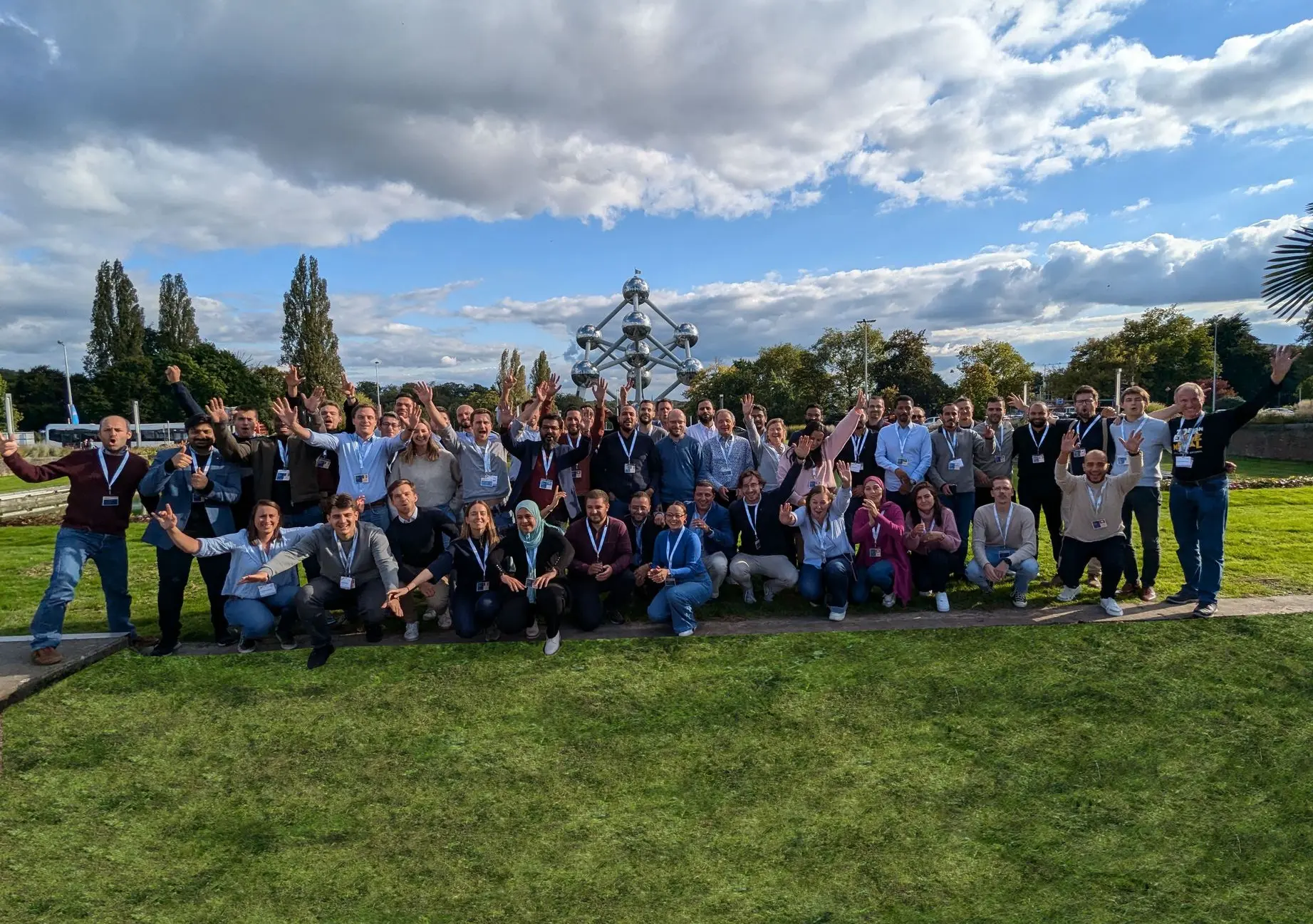
Our consultants come from the SAP and Microsoft Dynamics world. They don’t just implement Odoo — they understand what you’re leaving behind, what matters in the transition, and what your teams will need long after go-live.



ANOTHER APPROACH
Keep your core ERP and add Odoo
Replacing everything is not always the right strategy. We can keep your core ERP (SAP, Microsoft Dynamics, NetSuite) and deploy Odoo alongside it, where it adds the most value. A shorter, more focused project, without touching the group system.
A new activity or a subsidiary
Quickly equip a new entity or business unit with Odoo, without waiting for a group-wide project.
Fill the gaps in the core ERP
Add Odoo where SAP, Dynamics or NetSuite reach their limits: CRM, HR, event management, customer portals.
They trust us with their ERP migration

INDUSTRY SOLUTIONS
Solutions designed for your industry
Beyond the migration, we know precisely where standard Odoo stops for each sector, and we have already built the modules that close the gap. You do not start from a blank page: you start on a base proven in your industry, designed to stay up to date.
Retail
Stores, e-commerce and inventory synchronised on a single platform.
Already deployed at Dreambaby, Baobab.
See the Retail solution →
Manufacturing
From the shop floor to the margin, your production managed in real time.
Already deployed at Desimone.
See the Manufacturing solution →
Energy
The installer’s entire business, from quote to after-sales.
Already deployed at Luminus, Quito.
See the Energy solution →
Construction
Sites, invoicing and profitability in a unified ERP.
Already deployed at M2O, Benoit Bernard.
See the Construction solution →
Food & Beverage
Traceability, production and inventory controlled end to end.
Already deployed at Corica, Kult Kefir, Woodster.
See the Food & Beverage solution →
Logistic & Transportation
Operations, logistics and finance connected, margin per job in real time.
Already deployed at Polytra, LSC Logistics.
See the Transport & Logistics solution →
Professional services
Projects, services and profitability on time spent.
Our approach adapts to your business
Our approach adapts to your business, even beyond these verticals. Let us talk about your activity and your constraints, and see what Odoo can change.
Discuss your caseFAQ
ERP Migration to Odoo: your questions answered
Yes. Odoo has more than 12 million users worldwide, with deployments at 500, 1,000 and 2,000 concurrent users. The perception that “Odoo is for small businesses” dates back to 2015. Our typical client is a structured SME or a mid-sized company, with several departments, entities or countries.
For an SME or a mid-sized company, yes in the vast majority of cases. Odoo now covers the functional scope of older SAP and Dynamics versions, in an integrated platform that is far cheaper to run. The right answer depends on your exact scope, which we validate during the scoping audit.
Over five years, Odoo’s total cost of ownership is generally 57 to 63% lower than an equivalent Business Central or S/4HANA. The gap reaches 74 to 80% on the initial project cost alone (first-year licences, implementation, training). The exact figure depends on the size of your organisation, the functional scope and the level of integration. Our scoping audit gives you a precise figure for your case, based on facts rather than a flat rate.
For an SME or a mid-sized company, the decisive question is the total cost over five years, not the entry price. A S/4HANA migration is a long (often 18 to 36 months) and costly project that heavily ties up your internal teams. RISE with SAP looks attractive on paper, but once extended maintenance, named-user licences and data migration are factored in, its TCO often exceeds that of an on-premise S/4HANA after three years.
Odoo enters the comparison where SAP covered needs that are now served natively by a modern, integrated platform. For very advanced functions (advanced reporting, complex planning), Business Central and S/4HANA keep the edge out of the box: this is precisely what the scoping audit settles, without bias.
For an SME with a standard scope (finance, sales, purchasing, inventory), allow a few months between signature and go-live. For a multi-entity mid-sized company with production and third-party integrations, allow around a year. The most decisive factor is the quality of the existing data and the availability of your key users.
The estate of ABAP developments (the Z-programs) built up over the years is the real hidden cost of a SAP migration, far more than the licence. Our audit tackles it through real usage: we analyse two months of actual system use to tell what genuinely serves a purpose from what lies dormant.
A large share of these developments maps to functions that have become native in Odoo, and so disappears along the way. The rest, genuinely specific to your business, is rebuilt while staying close to the standard. The result: you do not pay to rebuild useless legacy, and your future version upgrades stay manageable.
Most add-ons used on Business Central or SAP cover functions that are native in Odoo (Peppol, document management, expenses, mobility). In those cases, the add-on disappears along the way. For developments genuinely specific to your business, we rebuild them while staying as close as possible to the standard, which keeps future upgrades manageable.
Yes. Odoo integrates with Outlook (an official plugin to create leads and sync contacts), with your Microsoft 365 calendar and with Excel for your imports and exports. You keep your office suite for what it does well, and Odoo takes care of the integrated management of your business operations.
You lose nothing. Structured data (partners, items, entries, movements, orders) is migrated to Odoo. Historical documents (PDFs, scans, archives) can be kept read-only or migrated as needed. We help you decide what is worth actively migrating versus archiving.
No, it is in fact an asset. Odoo is published by a Belgian company (Odoo SA) that handles development, official maintenance and support. The Enterprise edition is under a commercial licence, with an identified publisher, contractual guarantees and a public roadmap. Open source means you are not locked into a vendor: access to the code, self-hosting possible, an active OCA community. It is the opposite of a risk.
Yes. Odoo natively includes AI features (invoice OCR, order suggestions, product descriptions, predictive analytics). The difference with proprietary suites like Copilot: Odoo lets you plug in the model of your choice (OpenAI, Anthropic, Mistral, even self-hosted for confidentiality). You are not locked into a single vendor’s stack. See our Eezee AI Suite.
After hypercare, you can take out an evolution contract . It keeps your Odoo up to date and performing over time: version upgrades included, support for your key users with SLAs, audits and continuous optimisation, and a predictable annual package. A bonus of up to 30% rewards replacing a custom development with a standard function, a concrete incentive to keep your system simple.
We know your current ERP from the inside (our experts come from the SAP and Microsoft Dynamics ecosystems), we have vertical solutions packaged for your industry, and our team stays stable from the first conversation through to support. We encourage you to compare several partners before choosing: an ERP project is a relationship of several years.

Ready to find out whether Odoo is the right answer for you?
The first conversation is without commitment. You walk us through your situation, we tell you whether Odoo is relevant, how we would proceed, and the rough order of timeline and budget.
The next step: a costed scoping audit.