Since the announcement of the mandatory working time tracking in Belgium starting January 1, 2027, one question keeps coming up from our clients: “We’re already using Odoo Timesheet, are we compliant?”
The honest answer: maybe, but not necessarily. Here’s why, and how to get a clear picture.
What the law actually requires
Before comparing the two tools, let’s first recall what the 2027 obligation actually requires. Through two rulings of the Court of Justice of the European Union CCOO vs. Deutsche Bank in 2019 and Loredas in 2024 and as confirmed by the Belgian federal government in November 2025, the obligation requires every Belgian employer to have a system in place:
- Objective: data cannot be manually modified after the fact
- Reliable: records are time-stamped, traceable, and secure
- Accessible: available to each employee, regardless of their working context
And in concrete terms, this system must at least record the start time, end time, and break periods for each work session. The final law will be published during 2026 but these three criteria are already clearly defined.
It is precisely around these requirements that the difference between Odoo Attendance and Odoo Timesheet becomes significant.
Odoo Attendance: the direct answer to the law
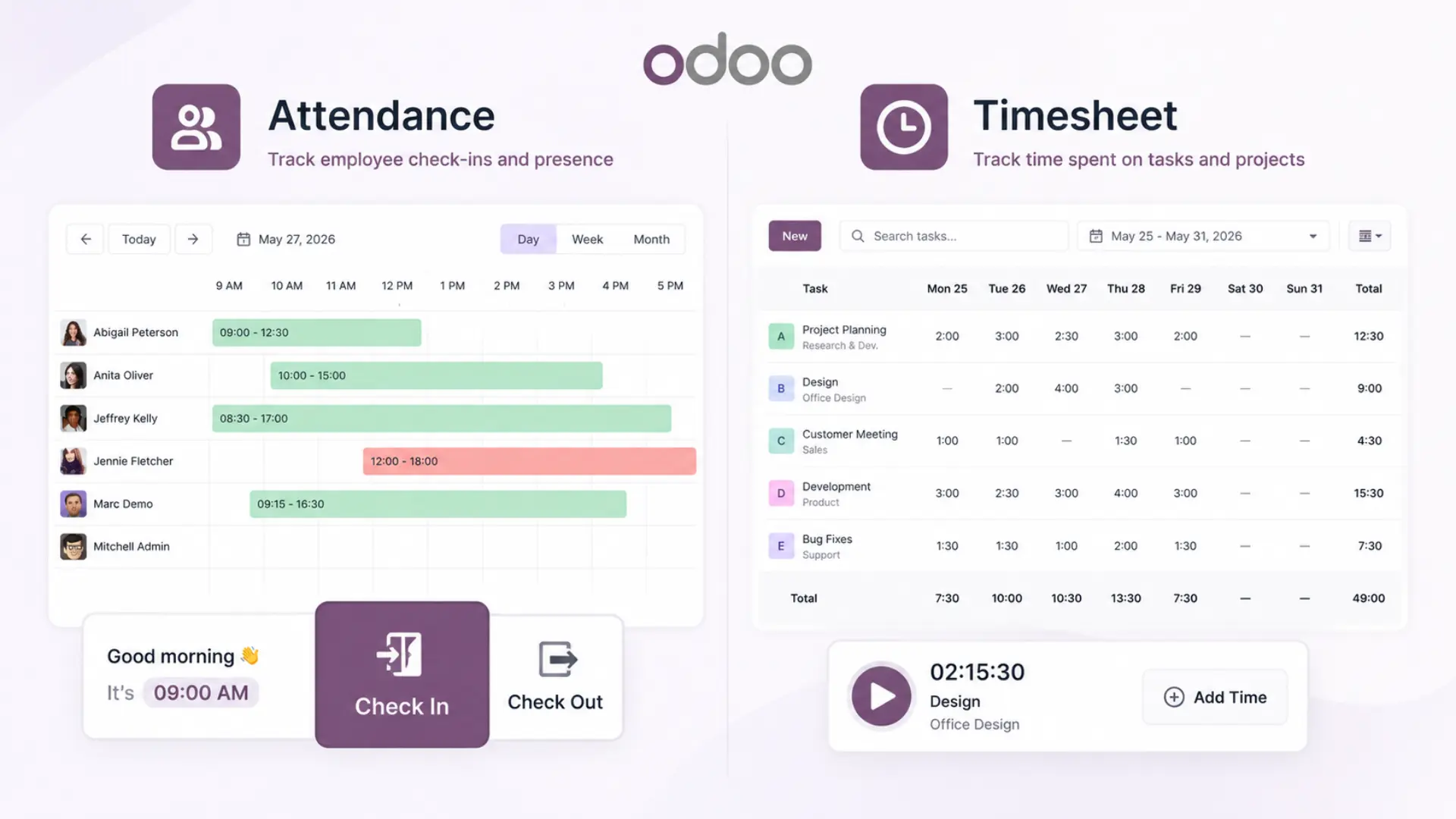
Odoo Attendance is a digital time clock. Its role is simple and precise: to record when an employee starts working, when they stop, and to automatically calculate breaks and overtime.
How it works
Each employee “clocks in” and “clocks out”. Odoo automatically timestamps every entry and links it to the employee’s identity. It is impossible to modify an entry afterward without leaving a trace directly meeting the CJEU’s requirement for objectivity.
Clocking methods and identification options
This is where things become very concrete: how will your teams clock in on a daily basis? Odoo Attendance adapts to every work environment:
- Web interface : each Odoo user clocks in directly from their browser, in one click, from any device
- Mobile application : ideal for remote teams, field workers, or on-site operations
- Tablet kiosk : a dedicated tablet at the workshop or office entrance, without requiring an individual PC
- RFID badge / NFC card : employees scan their card, and the entry is recorded instantly
- Personal PIN code : each employee has a unique code, usable on the kiosk
- Facial recognition : automatic identification via camera, contactless and without forgotten badges. Eezee-it has already deployed this for several clients in Belgium
- Fingerprint recognition : biometric identification via a fingerprint reader connected to the kiosk, deployed for several Eezee-it clients
- QR code : each employee has a personal QR code to scan
Facial and fingerprint recognition: what you need to know
These technologies are particularly useful in environments where employees have their hands occupied (gloves, tools) or cannot easily handle a badge. They require special attention regarding GDPR compliance biometric data is sensitive. Eezee-it supports you on this aspect during deployment.
Which sectors is Odoo Attendance particularly suited for ?
Odoo Attendance applies to all sectors the law requires it for everyone. However, some contexts benefit especially from its flexibility :
- Manufacturing & production : shifts, teams, night and weekend work, workshop clocking without PCs. Legal obligation already partially in force for variable schedules since July 2024
- Construction & worksites : multi-site teams, mobile GPS clocking, site managers who don’t return to the office. Sector already subject to specific obligations
- Transport & logistics : drivers, warehouses, staggered schedules. Regulated sector with existing recording obligations
- Horeca : part-time staff, student workers, variable schedules. Sector subject to specific obligations and frequent inspections
- Cleaning : electronic time tracking mandatory since January 1, 2025. If you are in this sector, you must already be compliant
- Retail & commerce : multi-site operations, part-time staff, workforce rotation. Kiosk clocking per store
- Energy & installations : field technicians, on-site interventions, flexible schedules. Mobile clocking with location tracking
- B2B services & consulting : remote work, flexible schedules, autonomous teams. Web or mobile clocking, with possible integration with Timesheet
What Attendance brings beyond compliance
Beyond legal compliance, Odoo Attendance centralizes everything related to presence and working time:
- Automatic overtime calculation with configurable tolerances
- Integrated absence management leave, sickness, compensatory time in the same tool
- Real-time manager dashboards who is present, who is absent, what anomalies exist
- Native integration with Odoo Payroll recorded hours directly feed salary calculations
- Complete, exportable history for social inspections
Odoo Timesheet: much more than a compliance tool
Odoo Timesheet serves a different purpose. While Attendance answers “when is this employee working?”
Timesheet answers “what are they working on and for how long?”
It is a time-tracking tool by activity per project, client, or task. Each recorded hour is linked to a specific context, allowing you to calculate project costs, bill time without re-entry, and analyze profitability per client.
What Timesheet brings in practice
- Integrated timer start and stop the timer directly from a task or the dashboard. Time is recorded automatically
- Automated time-based billing validated hours directly generate customer invoice lines. You bill everything that has been delivered, with no omissions
- Profitability by project and client planned vs actual hours in real time. You can identify projects that are exceeding budget before it impacts your margins
- Managerial validation approval workflow with automatic reminders. Only validated hours are used for billing
- Integration with Odoo Project, each task is linked to its actual time, and project progress is visible without leaving the tool

“I do not care if someone comes at 8:15 or 8:30, but I do care to know how much time they took to do a specific task. Odoo helps us a lot with time tracking and timesheeting. It is automatically linked to the project so that I can have a live view of the profitability of each and every project.”
Axel Soyer, CEO · Desimone, Charleroi (industrial robot manufacturer)
The real difference between the two
The confusion comes from the fact that both tools record time. But they do not answer the same question and they are not interchangeable.
| Criterion | Odoo Attendance | Odoo Timesheet |
| Core question | When is this employee working? | What is the employee working on? |
| Records start/end time | Yes, automatically | Not always explicitly |
| Meets EU Court requirements (CJUE) | Yes, clearly | To be confirmed by the 2026 law |
| Project/client tracking | No | Yes |
| Time-and-materials billing | No | Yes |
| Payroll integration | Yes, native | No directly |
| Ideal for | Manufacturing, construction, all sectors | Services, consulting, project-based work |
In summary : Attendance covers legal compliance. Timesheet covers profitability and billing. These are two complementary tools, not alternatives.

A concrete example to understand
the value of both together
Imagine an employee in a services company. At the end of the day, their Odoo showy
- Attendance: 8h42 of presence : they arrived at 8:30, left at 5:30, with 18 minutes of recorded breaks
- Timesheet: 7h30 billable : 4h on client project A, 2h on project B, 1h30 in internal meetings
- Gap: 1h12 : administration, internal movements, non-recorded breaks
This gap is normal. It is even valuable: it shows how much “non-billable” time your team spends each day. Across 20 employees, this becomes an HR and business steering metric you likely didn’t have before.
That is the value of using both together. Attendance measures presence. Timesheet measures production. One without the other only gives you half the picture.

Is timesheet alone : sufficient for 2027 ?
This is the most common question our service-sector clients ask. And the honest answer is: we don’t know yet with certainty. Here is why.
The law requires recording the start and end time of each work session. Odoo Timesheet records time spent on an activity but not necessarily with a strict legal start-and-end timestamp. An employee can, for example, log 3 hours on a project at the end of the day, without the system knowing exactly when they actually started working.
In other words, Timesheet is a management tool, not necessarily a social control tool. It measures what you do, not when you do it. This distinction is important in the context of 2027 compliance.
That said, the final law has not yet been published. It is expected in 2026 and could include adapted rules for service companies where work is inherently project- and client-based. We are closely monitoring these developments, and our clients will be informed as soon as the requirements are clarified.

Our recommendation in the meantime
If you are already using Odoo Timesheet and are wondering whether to add Attendance, there is no need to panic. But you should also not postpone the reflection until 2026. The final regulation will take time to be understood and implemented and a proper deployment typically takes 3 to 6 months. It is better to assess your situation now and define a clear roadmap.
The link between the twoand what Eezee-it can configure
The good news: in Odoo, Attendance and Timesheet are two tools within the same system. They don’t operate in silos the data lives in one place, visible together and automatically comparable.
But Eezee-it can go further depending on your situation.
For manufacturing and field companies
Your teams clock in via Attendance in the workshop, on-site, or from their smartphone. Eezee-it configures the link so that each clock-in automatically feeds the right project in Timesheet. Your operators don’t enter anything manually: they clock in, and costs are calculated in real time.
That’s exactly what we implemented at Desimone in Charleroi: teams clock in at the workshop, time is automatically allocated to projects, and the CEO gets a real-time view of the profitability of each machine produced.
For service companies
Your teams log their time in Timesheet by project, by client, by task. Eezee-it can configure the reverse link: each Timesheet entry automatically generates the corresponding Attendance record, with start and end times. You keep your existing workflows, and you stay legally compliant.
What is standard and what is configured by Eezee-it
Standard Odoo already allows you to view Attendance and Timesheet side by side the data is in the same system and discrepancies are automatically detected. The automatic link between the two, in one direction or the other, is a configuration set up by Eezee-it based on your organization. This is what we assess together during an initial call.
Already using Odoo timesheet ?
Let’s review your current setup together and define what needs to be adjusted to be compliant by 2027 without rebuilding everything from scratch.

FAQ
Odoo Attendance, Timesheet and 2027 compliance.
This is a legitimate question, but it is not yet fully settled. The law requires recording start and end times something that Timesheet alone does not always guarantee. The final legislation (expected in 2026) will clarify the requirements for service companies.
In the meantime, the safest solution is to have Attendance enabled or to configure the Timesheet → Attendance link with Eezee-it.
No. In Odoo, Attendance and Timesheet are two applications included in the same license. You do not pay per module, you pay per user. Both tools are available within the same Odoo subscription.
Yes. Belgian law does not require a physical time clock, it requires an objective, reliable, and accessible system. Odoo Attendance meets these three criteria: automatic, non-modifiable time stamping, tracked and secured data, and access via kiosk, web, or mobile. This is exactly what the CJEU requires.
If your priority is 2027 compliance, start with Attendance, it is the most direct and reliable answer to the legal requirement. If you also need project tracking and time-and-material billing, then add Timesheet from the start.
Both can be deployed together and naturally complement each other. A call with our team can help define the right scope for your situation.
Yes, this is one of Odoo’s key strengths. Approved timesheets can directly generate customer invoice lines. No re-entry, no export, data flows automatically between Timesheets, Projects, and Invoicing within the same system.
For a proper deployment including configuration, payroll integration, team training, and go-live, you should expect between 3 and 6 months, depending on your company size and existing infrastructure.
That’s why we recommend starting the project in 2025 rather than waiting until 2026.
Odoo Attendance vs Odoo Timesheet: what’s the difference, and which one do you need to stay compliant in 2027?