
- The common thread running through Odoo 20
- 1. gentic AI: the real paradigm shift in Odoo 20
- Our view on AI in Odoo
- 2. Field Service + Planning merger: the redesign for service businesses
- 3. Odoo 20 Accounting: three developments finance teams have been waiting for
- 4. Data and operational management: Odoo 20 finally strengthens operational analytics
- What about Odoo 20 verticals?
- Should you migrate to Odoo 20?
- A migration is also an opportunity
- Our migration team
Odoo 20 will officially be presented at Odoo Experience in Brussels, from September 24 to 26, 2026. The roadmap was unveiled on April 2, 2026, during Odoo Partner Day, by Luc Nailis, Product Owner at Odoo, in front of the entire network of certified partners, including Eezee. It contains dozens of changes. As with every version, the ecosystem will produce exhaustive lists of “everything that is changing in Odoo 20.”
This article takes the opposite approach. Rather than listing everything, we focus on the four strategic changes that will genuinely matter to an SME the ones that, on their own, are enough to make a CEO or finance manager take an interest in Odoo 20.
Before we start, one useful clarification: a roadmap is not a released version. Odoo itself makes the point with a touch of humor: a roadmap is a “list of things we may or may not do.” Some features will evolve before the release. What we are discussing here is the strategic direction, not a definitive commitment.
The common thread running through Odoo 20
If we take a step back and look at the new features in Odoo 20, a clear pattern emerges. Odoo is moving away from simply adding modules and is starting to merge them. At the same time, the platform is making decisions that align with the requirements of more mature companies: scalability, automation, and data-driven management.
For companies that already have an organized finance team, formalized processes, and a genuine dependence on their ERP, this is an important signal. Odoo continues to move upmarket within the SME segment, and Odoo 20 confirms that trajectory.
Four developments deserve serious attention: agentic AI, the Field Service / Planning merger, Accounting improvements, and the qualitative leap forward in data and operational management. The rest — Payroll redesign, the new mobile interface, the redesigned Calendar, Point of Sale, Sign, Discuss are mainly incremental improvements: real and useful, but less structurally significant for the majority of our clients.
1. Agentic AI: the real paradigm shift in Odoo 20
This is probably the most structurally significant change in this version. Until Odoo 19, AI remained essentially passive. It could read, summarize, and suggest. It did not interact with the data.
Odoo 20 crosses that line. The assistant becomes an agent capable of executing actions in the database based on a natural-language instruction. For a structured SME, this opens up concrete use cases that simply did not exist before.
- Mass reassignment across complex pipelines
A sales team with a CRM pipeline containing several hundred leads can now ask the AI: “Reassign all of Marc’s leads that have not yet been won, except those in the industrial sector, which should remain with Sophie.” The AI identifies the relevant records, applies the changes, and confirms the number processed. Without this type of agent, this would mean hours of manual work or a custom development.
- Automatically structuring projects from documents
“Based on this PDF specification, create a project with its stages and tasks.” The AI reads the document, structures the project, and creates it in Odoo. For engineering firms, consulting companies, or IT services companies that regularly launch projects based on client specifications, the time savings are immediate.
- AI-assisted accounting audit
The AI agent presented in the roadmap under the name “Accounting for non-CFOs” reviews the quarter’s accounting entries, identifies unreconciled transactions, flags amount discrepancies, and produces a summary report. For a finance team managing the monthly close, this provides an additional layer of control without requiring additional human time. The finance manager arrives at the meeting with a pre-analyzed anomaly report rather than a list of checks still to perform.
Point to watch
This type of AI agent is only as effective as the quality of the data it works with. For clients whose database is clean — consistent analytic allocations, complete customer and supplier records, a well-structured chart of accounts — the added value will be real from day one. For those who have accumulated years of approximate configurations, the agent will mainly expose problems that need to be fixed before its full benefits can be realized. Ultimately, that is good news: Odoo 20 will provide an opportunity to carry out a genuine data quality audit.
Our view on AI in Odoo
AI is an area in which we have been investing heavily at Eezee for more than a year, because we are convinced that this is where the next major evolution of the Odoo ecosystem will take place. Code is becoming increasingly commoditized, while value is shifting toward the intelligent orchestration of data, processes, and business tools.
This is precisely what led us to develop Eezee-IT AI Harness, our dedicated offering for integrating AI into Odoo in a secure and controlled way. AI Harness combines three complementary components: a cloud platform managed by Eezee, a marketplace of applications and skills developed by our dedicated AI team, and a native connection to coding agents such as Claude to accelerate development, testing, and releases in Odoo.
The purpose of the product is simple: Odoo 20 opens the door, but raw AI is not a ready-to-use solution for an SME. It requires a framework, safeguards, and validated business use cases. That is precisely what AI Harness provides, allowing us to support our clients on these topics without requiring them to become AI experts themselves.
Want to know more about Eezee-it Harness ?
2. Field Service + Planning merger: the redesign for service businesses
For SMEs that carry out field operations industrial maintenance, troubleshooting, installation, or technical services at the customer’s premises this is the Odoo 20 development that will have the greatest operational impact.
Until now, Field Service and Planning were two overlapping modules that did not communicate properly. The manager scheduled resources in Planning, the technician worked in Field Service, and synchronization between the two was handled manually. For an SME with dozens of field technicians, the result was predictable: duplicate data entry, coordination errors, and a manager who never had a unified view of the teams’ actual workload.
Odoo 20 merges the two modules into a single application, with one interface for planning both human and material resources.
What changes in practice:
- Travel time visualization between interventions directly in the Gantt view.
- A routing optimizer that calculates the order of interventions based on addresses, with a choice between “respect the entered order” and “optimize the shortest route.”
- Real-time tracking of technicians’ locations on a map.
- Assignment of equipment and tools directly to technicians, with automatic addition to the resources for the scheduled time slot.
- An offline mode allowing technicians to continue working without a network connection, with automatic synchronization once the connection is restored.
- Automatic invoicing triggered when the customer signs on the technician’s phone.
This is a complete redesign of the workflow from intervention to invoicing, affecting everyone from a tradesperson managing a few jobs to a maintenance company handling dozens of recurring contracts. For teams of several dozen technicians, every productivity improvement, even of just a few percentage points, translates into full-time equivalent capacity recovered over the year.
Point to watch
On paper, it is spectacular. In practice, the benefits will not be automatic. Intervention forms, service types, automatic invoicing rules, technician profiles, and geographical areas all need to be configured carefully for the merger to deliver its full potential.
What we observe with our clients on this type of project is that the difference between a merger that genuinely saves time and one experienced as a cosmetic migration comes down entirely to the time spent beforehand defining and structuring business processes. Underestimating this point guarantees that the investment will not deliver its full benefits for a year and a half. Get it right, and technician time can be recovered as early as the first quarter after the transition.
Field Service deserves to be covered in a dedicated article: workflows differ radically depending on whether we are talking about one-off troubleshooting, recurring maintenance contracts, subcontracting, or event equipment rental. We are preparing a dedicated article with concrete use cases by industry — coming soon to the blog.
3. Odoo 20 Accounting: three developments finance teams have been waiting for
Accounting may not be the most exciting module, but it is the one that determines the maturity of an ERP for a company of fifty employees or more. On this front, Odoo 20 takes a real step forward, with three developments that directly address the needs of finance managers and controllers.
4. Data and operational management: Odoo 20 finally strengthens operational analytics
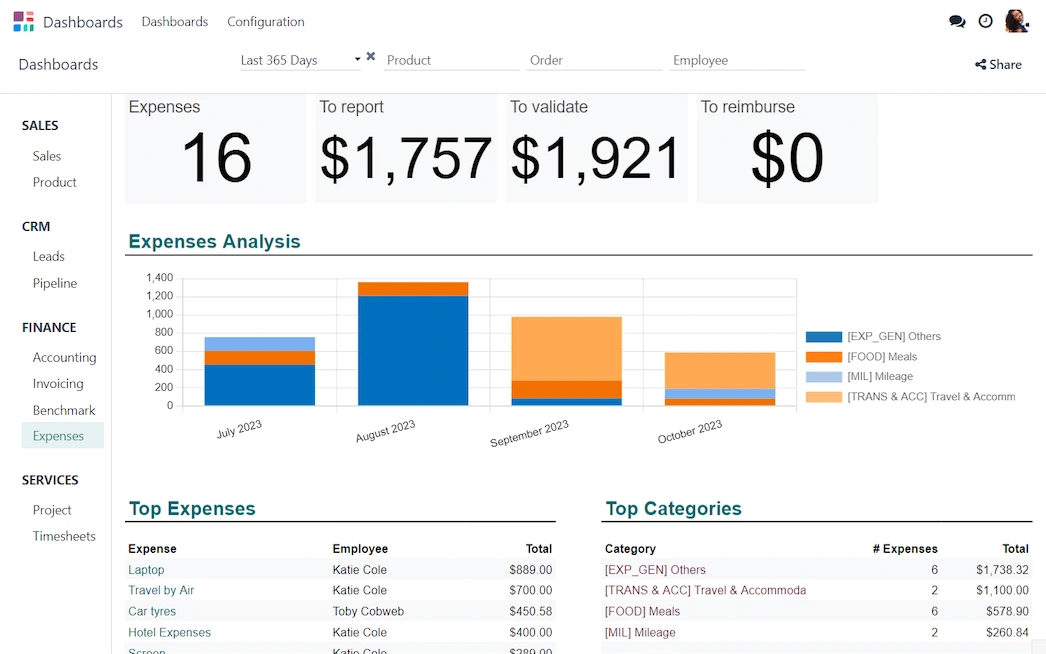
For a structured SME, data-driven management is no longer optional. This is precisely where Odoo had long had a weakness: rich data in the database, but analytical capabilities that lagged behind dedicated BI tools. Odoo 20 is beginning to seriously close that gap.
What about Odoo 20 verticals?
Odoo 20 focuses on enriching its industry-specific verticals: Construction, Hospitality+, Recruitment Agency, Automotive Garage, Nursing Home, and others. On paper, this is attractive: pre-configured packages with business workflows already in place.
Let’s be honest: Odoo’s standard verticals do not meet the real-world needs of a mature SME.
This is precisely what led us, from our first industry-specific projects, to build our own business verticals rather than starting from Odoo’s official packages:
- Construction: quotations by trade, progress billing, retention amounts, change order management, subcontracting integration.
- Retail: omnichannel flows, advanced promotion management, unified POS / e-commerce / inventory integration.
- Logistics & Transport: transport orders, route optimization, shipment tracking, telematics integration.
- Food: batch traceability, best-before/use-by date management, HACCP compliance, production / distribution flows.
- Manufacturing: detailed bill of materials and routing management, shop-floor planning, actual cost calculations, PLM integration.

These verticals are built on the Odoo standard, but add the business layer genuinely expected by mature companies in each industry. This allows us to deliver solutions that can perform reliably in production, within reasonable timelines, without accumulating custom developments throughout the project.
The message is simple: if you are evaluating Odoo for a vertical-specific project, do not rely solely on the commercial information provided for standard packages. Ask your partner to show you concretely how they enhance these verticals so that they can deliver on their promises in real-world operations.
Should you migrate to Odoo 20?
The real question is not “Should we migrate as soon as September 2026?” It is: “Are the new features in Odoo 20 worth upgrading for my company?”
And the answer depends on your current situation.
- If you are running a recent version Odoo 18 or 19 and your processes are working well, there is no rush. You can calmly plan an upgrade to the stable Odoo v20 in the first quarter of 2027, once versions x.1 and x.2 have been released in November and December 2026, bringing stability fixes.
- If you are running Odoo 17 or older, the question is different. Our recommendation is not to skip more than one major version at a time, because differences in database schemas, APIs, and behaviors quickly become difficult to manage. Migrating to Odoo 19 by the end of 2026, and then to Odoo 20 once it has stabilized, is generally safer than attempting a direct jump.
One specific point to monitor for our French clients: the certification of the Accredited Platform (Plateforme Agréée, PA) for electronic invoicing is expected in September 2026, before the release of Odoo 20. Companies affected by the electronic invoicing requirement at that deadline should therefore plan around their V19 instance rather than anticipating a move to V20 in order to meet compliance requirements on time.
Our underlying belief: a migration every three years is a good pace for an SME. It is frequent enough to benefit from major developments without turning maintenance into a permanent project.
A migration is also an opportunity
The classic mistake is to treat an Odoo migration as a purely technical operation. Yet this is precisely the moment when business processes deserve to be reassessed.
The questions that naturally arise are: which custom modules have become unnecessary because their functionality is now available in the standard solution? Which external integrations can be simplified? Which processes have become more cumbersome over time without anyone noticing? Which data has become outdated and should be cleaned up before the transition?
This is the approach we systematically take with our clients: a migration is accompanied by a functional audit and a process review. Not to make the project longer, but to ensure that, by the end, the company has gained operational clarity rather than simply changed versions.
Our migration team
At Eezee, we have a dedicated Odoo migration team. It handles the technical analysis OCA modules, custom modules, integrations as well as planning, testing, and production deployment. This specialization allows us to maintain controlled timelines, even on heavily customized Odoo instances.
If you would like to learn more, you can find all the details on our Migration page.
In summary
Odoo 20 is not a revolution. It is better than that: it is a maturity release. It is not trying to dazzle users with a spectacular feature; it is focused on making the platform more seamless, more intelligent, and more operational for the companies that rely on it every day.
The four strategic developments in this version agentic AI, the Field Service / Planning merger, Accounting improvements, and the qualitative leap forward in data and operational management address real and concrete needs. But as always, the benefits will not be automatic. They will depend on the quality of the preparation, the cleanliness of the data, and the partner supporting you.
The goal is not to rush into an upgrade in September 2026. It is to define now what this version can genuinely bring to your business, and to prepare a migration that is also an opportunity for improvement.
Meet our expert !
Are you preparing an Odoo 20 migration, or do you want to assess what this new version can concretely bring to your business?
Contact us to discuss it.

Odoo 20: The 4 Strategic Changes That Will Matter for Your SME