In construction companies, the profitability of a project is often analyzed once the project is completed, when invoicing is closed and accounting consolidates the costs.
But at that stage, it is too late to correct deviations or secure the margin.
Profitability does not depend solely on the price agreed with the client. It relies on the ability to structure quotations, track costs during execution and analyze projects to improve the next ones.
This is exactly what an Odoo ERP for construction makes possible: connecting estimation, field operations, invoicing and accounting within the same flow. This continuity transforms profitability from a result that is simply observed into an indicator that can truly be managed.
Why construction project profitability is often poorly measured
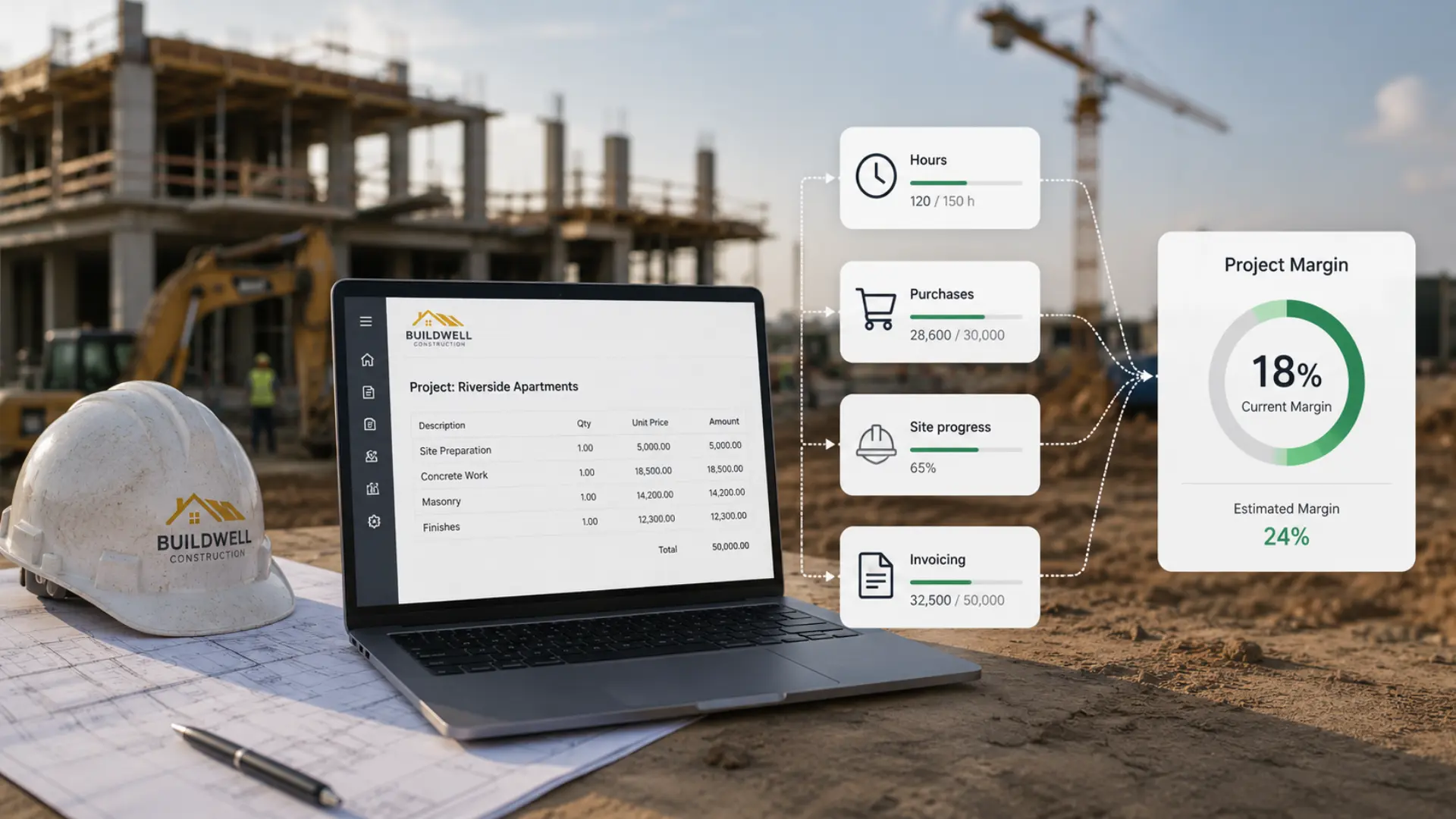
In construction, the profitability of a project does not depend only on the price agreed with the client. It mainly depends on the gap between what was estimated, what was actually carried out and what was ultimately invoiced.
This gap often appears very early in the project and can evolve throughout the entire construction process.
The gap between estimation, execution and invoicing
A quotation is always based on an estimation, and a clear quote already means a controlled project. Even when it is precise, it relies on assumptions: planned quantities, execution conditions, team organization or resource availability.
But once the project starts, reality may evolve. Technical adjustments, unexpected constraints or differences between plans and on-site conditions gradually alter the initial balance. Some tasks take longer than expected, others require adjustments or generate indirect services that are difficult to value.
If these gaps are not monitored continuously, the actual margin quickly drifts away from the planned margin.
Visible costs… and others that are more diffuse
Materials, subcontracting or working hours are the most obvious costs on a construction project. But a significant part of profitability depends on less visible elements: internal organization, indirect time, coordination, logistics, equipment immobilization or structural costs.
Without a clear method to connect these costs to projects, the reported profitability can give a misleading impression. The project appears profitable, while part of the expenses remains diffuse or poorly allocated.
Why accounting alone is not enough
Accounting makes it possible to determine the result of a project once expenses have been recorded and invoicing finalized. It provides a reliable snapshot, but a late one.
However, construction project profitability is not determined when the books are closed. It is built throughout the entire project. If deviations only become visible at the end of the project, it becomes impossible to adjust the organization, anticipate issues or secure the margin.
This is why the real question is not only to know the profitability, but to be able to monitor it during execution.
The real issue: managing profitability before, during and after the project
The profitability of a construction project cannot be reduced to a final result. It depends on a series of decisions made before the project starts, during its execution and after its completion.
To truly manage it, profitability must therefore be monitored over time, and not only analyzed afterwards.
Before the project: securing the expected margin
Project profitability begins with the quotation.
This is where the assumptions that will determine the future margin are structured: material quantities, estimated time, hourly costs, team organization or subcontracting needs.
When these elements are precisely defined, it becomes possible to estimate the profitability of the project even before it starts. The quotation no longer serves only to set a price for the client, but becomes a real financial management tool, as long as the quotes and take-offs feeding it are connected to your ERP rather than stranded in Excel.
In an environment organized around a construction ERP like Odoo, each quotation line can be linked to a real cost. The estimated margin is therefore no longer based on a rough approximation, but on a consistent calculation base.
During the project: tracking construction profitability in real time
Once the project has started, the margin does not remain fixed. It evolves according to the reality on site: actual hours worked, additional purchases, unexpected interventions, additional subcontracting or adjustments requested by the client.
Tracking profitability in real time therefore requires linking this information to the project. Hours must be allocated to the job, purchases associated with the relevant tasks and invoicing must reflect the real progress of the work.
When this data is consolidated throughout the project, deviations appear earlier. It becomes possible to adjust the organization, anticipate the impact on the overall margin or secure invoicing.
This continuous visibility is precisely what allows some companies in the sector to better coordinate their resources and projects, as observed at VLM after centralizing their planning, teams and operations within a single system.
After the project: analyzing to improve
Closing a project should not only serve to establish the final result. It is also a source of learning for future projects.
This is where analytical accounting becomes particularly valuable. It makes it possible to compare margins between projects, identify the most profitable types of work, analyze team performance or evaluate profitability by client.
This analysis transforms past projects into useful data to improve future estimations, adjust pricing strategies or better allocate resources.
For example, this is what enabled the company M2O, active in the construction and maintenance of swimming pools, to structure its financial and operational management. By linking quotations, field interventions and accounting within a single system, the company was able to absorb a strong increase in intervention volume while maintaining a clear view of its profitability.
What a solid construction workflow in an ERP like Odoo enables
To truly manage the profitability of a construction project, it is not enough to track financial indicators. Operational, commercial and accounting data must be connected.
This is exactly what a structured workflow in a construction ERP enables: connecting commercial, operational and accounting data so that profitability can be managed, not just observed.
Structuring the margin from the quotation stage
In an environment organized around a construction ERP like Odoo, the quotation is no longer limited to a global estimate. It becomes the foundation of the project’s financial monitoring.
Each line can include precise information: planned materials, estimated time, required resources or associated costs. Product costs and hourly costs can be defined in advance, making it possible to obtain a reliable estimate of the total project cost.
The expected margin therefore becomes a management indicator even before the work begins.
Connecting field operations to financial management
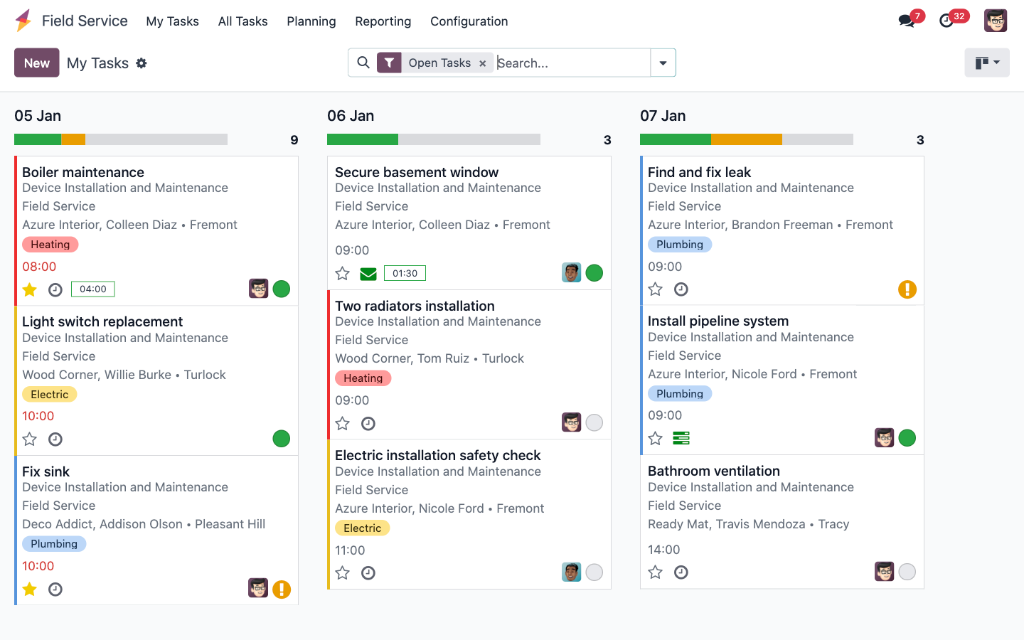
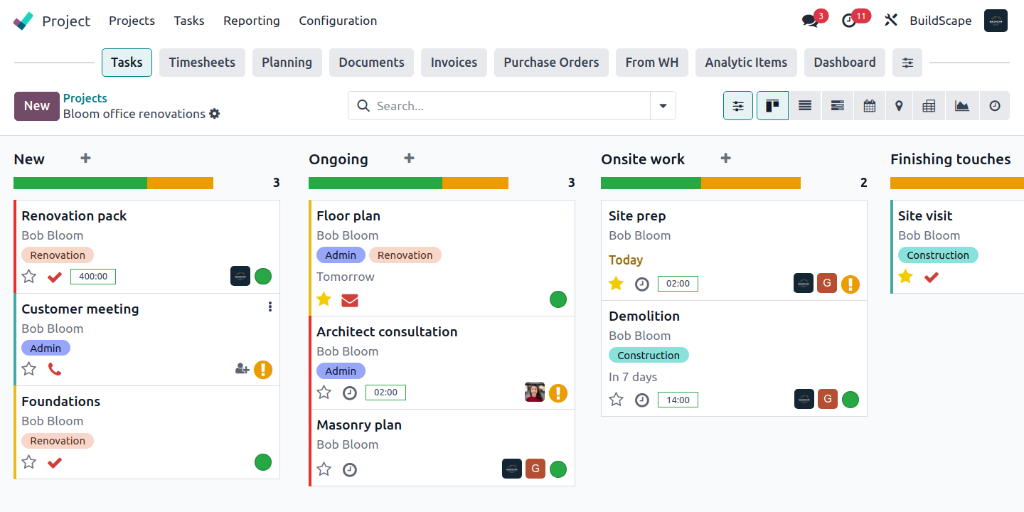
During project execution, information coming from the field can feed directly into the project: hours logged by teams, purchases allocated to the project, subcontractor interventions or adjustments made along the way.
When these elements are linked to the project as soon as they are recorded, it becomes possible to continuously compare the actual cost with the estimated cost. Deviations appear earlier, making it possible to act before the margin is permanently impacted.
Invoicing can also reflect the real progress of the work, integrating additional services or adjustments without having to reconstruct the information afterwards.

Using analytical accounting to manage the business
Once the data is consolidated, analytical accounting makes it possible to go beyond a project-by-project view.
It enables profitability analysis by project, by type of work, by client or by team. These indicators provide a more strategic reading of the activity and help identify improvement opportunities.
Profitability then becomes not only an observed result, but also a decision-making tool for future projects.
The real value is not knowing the margin, but managing it
In construction, the profitability of a project is not only a financial result. It reflects the company’s ability to correctly estimate its projects, track costs in real time and learn lessons for future projects.
Knowing the margin at the end of a project helps understand what happened. But managing profitability during the project makes it possible to influence the outcome, adjust the organization and secure the overall performance of the company.
When quotations, field monitoring, invoicing and accounting are connected, profitability stops being a late piece of information. It becomes a living indicator that guides decisions and strengthens project control.
For construction companies, the challenge is therefore not only to measure profitability, but to rely on a system capable of managing it continuously — which raises a prior question: how to choose between an ERP and dedicated construction software.
Book a call

This article is part of our Odoo ERP expertise for the construction industry.
Discover how we support construction companies on our Solutions page.
Discover our Construction Solution
FAQ : Construction project profitability and ERP
A project's profitability is calculated by comparing the actual cost (hours, purchases, subcontracting, indirect costs) with the amount invoiced, work package by work package. The challenge is not the calculation but the data collection: as long as this information lives in separate files, the result only appears once the project is finished.
The planned margin is calculated at the quotation stage, based on assumptions (quantities, estimated time, hourly costs). The actual margin is built during execution. The gap between the two is the real indicator to manage: tracked continuously, it can be corrected; discovered at closing, it is simply absorbed.
Because it is usually consolidated by accounting once the project is completed and invoiced. At that stage, there is no longer any lever to act on. This is exactly what connected tracking between quotation, field operations, invoicing and accounting changes: the margin becomes a living indicator rather than a final observation.
It is a breakdown of costs and revenues by axis (project, phase, work package, client) alongside general accounting. It is used to compare projects with one another, identify the most profitable types of work, and refine future estimates.
The duration depends on the scope: a foundation (quotations, projects, progress billing, analytics) is typically deployed in a few weeks to a few months, in stages. Eezee favors a progressive rollout with measurable results at each step. The budget is scoped according to the number of users and modules.
Managing construction project profitability: Why a construction ERP changes the game