
In many construction companies, the question of software first appears as an operational issue: better planning teams, tracking projects, centralizing information, or structuring quotes.
But as the business grows, this choice quickly goes beyond simple field management. It influences how the company can manage its margins, coordinate its projects, structure its accounting, and support its growth.
Choosing construction software or an ERP is therefore not just about selecting a tool. It means defining the architecture on which the company will rely to evolve.
Why construction companies first adopt construction management software
In many companies, the first need is not to transform the overall organization, but to improve operational tracking. Planning teams, structuring interventions, centralizing site information, or improving field communication quickly become priorities.
Specialized software effectively meets these needs. It helps organize daily operations, improves project visibility, and streamlines team workflows. For a company primarily looking to better manage its sites, this type of tool is often a logical first step.
Why construction management is no longer sufficient as the company grows
As activity increases, the question is no longer limited to field tracking. Managers need to understand the real profitability of projects, anticipate cash flow, coordinate multiple sites simultaneously, and maintain an overall view of the business.
At this stage, the challenge is no longer just about organizing project execution, but about structuring the financial and operational management of the entire business. Information must flow between quotes, projects, invoicing, and accounting to enable reliable decision-making.
This change in scale gradually transforms the software question. It is no longer just about managing sites, but about structuring the company.
Construction software and construction ERP: two different approaches
Construction management solutions are designed to optimize project execution. They improve planning, facilitate field tracking, and provide better operational visibility.
An ERP follows a different logic. It connects the commercial, operational, and financial dimensions of the company. It structures quotes, continuously tracks margins, integrates accounting, manages financial flows, and provides a consolidated view of the business.
The question is therefore not just which tool is the most complete, but which approach aligns with the company’s trajectory.
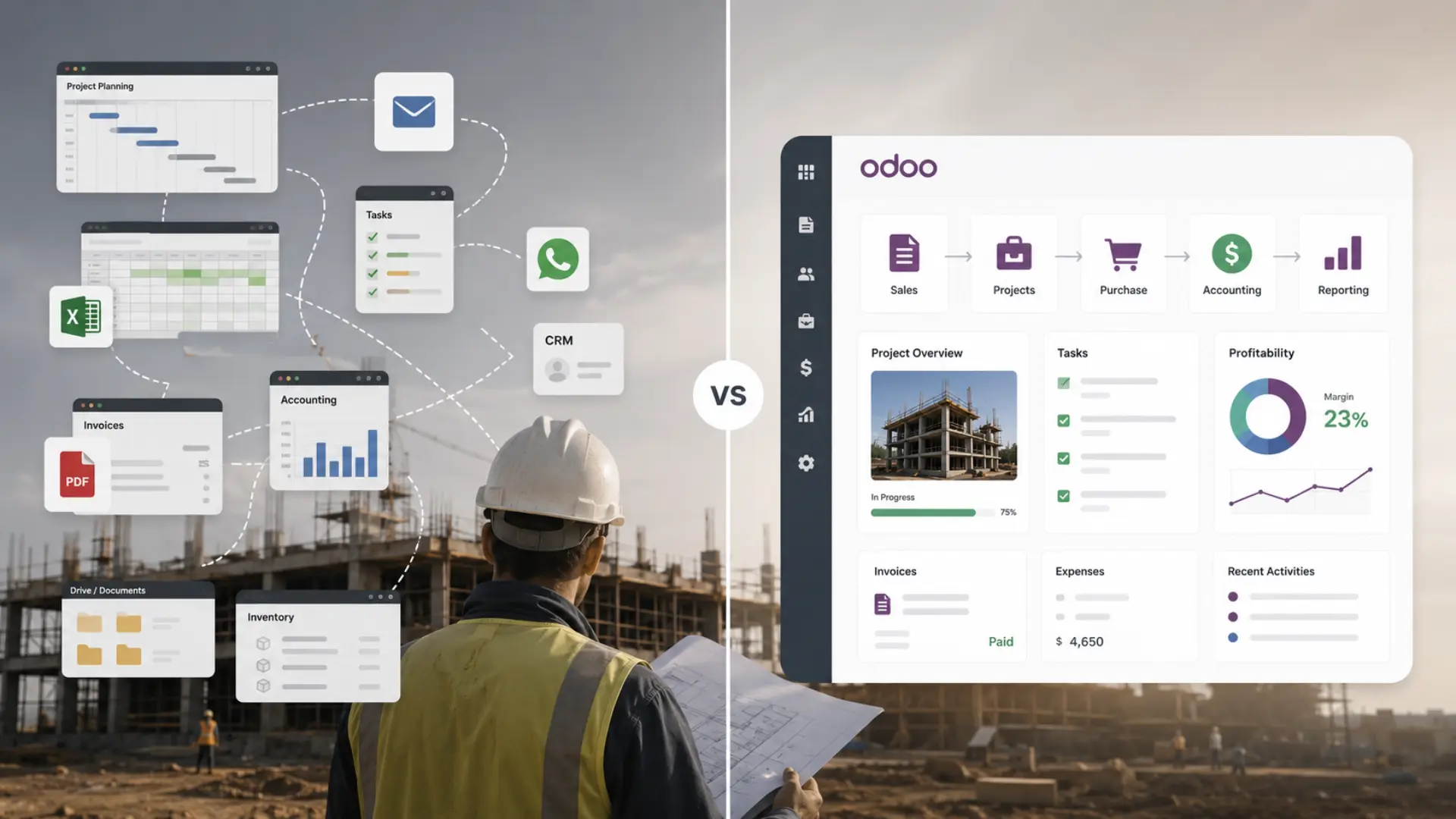
Why using multiple tools can weaken a construction company’s organization
In some situations, construction software effectively covers operational project tracking but does not handle other essential dimensions of the business, such as accounting, e-invoicing, website management, CRM, marketing, or inventory management.
The company must then complement its system with several specialized solutions. Individually, these tools perform their role well. But together, they gradually create a fragmented architecture where information flows through transfers rather than synchronization.
The real cost goes beyond software licenses
When multiple tools coexist, the cost is not limited to the price of each solution. It also includes maintaining integrations, verification processes, additional administrative time, and the difficulty of obtaining a reliable overall view.
This type of organization can slow down decision-making, delay invoicing, or complicate margin tracking. The issue is not the quality of each tool individually, but the coherence of the whole system.
A unified architecture simplifies management and reduces friction
A centralized system is not just about replacing multiple solutions. It primarily structures how information flows. Data from quotes, projects, invoicing, and accounting feed into each other, reducing duplicate entries and improving overall reliability.
The main benefit is not technical, but organizational: teams spend less time reconstructing information and more time managing the business.

The role of an ERP in structuring a growing construction company
As the business grows, the challenge is no longer just to execute projects properly, but to structure the entire company. Managers need a clear view of margins, cash flow, contractual commitments, and overall performance.
It is in this context that a modern ERP like Odoo fully makes sense in a construction company. Its role is not to replace operational tools, but to connect the commercial, financial, and organizational dimensions of the business into a coherent system.
Connecting quotes, projects, invoicing, and accounting in a single flow
In an organization structured around an ERP, the quote is no longer an isolated document. It becomes the foundation for project tracking, invoicing, and financial analysis.
Data from construction sites directly feeds invoicing, accounting, and margin management. Gaps appear earlier, decisions are based on reliable information, and management has a consolidated view of the business.
In open ERP solutions like Odoo, this continuity can be implemented progressively, also integrating tools already used by teams, such as Excel for quantity takeoffs or progress reports.
An ERP like Odoo can integrate the entire company’s operations
As the company evolves, new needs emerge: managing multiple entities, integrating accounting and e-invoicing, tracking inventory, automating sales processes, connecting the website, or leveraging data to anticipate decisions.
A structuring system must be able to absorb these dimensions without multiplying tools or fragmenting the organization. Its value lies not only in its current features, but in its ability to support the company’s long-term evolution.
An open ERP allows integration of existing business tools
In the construction sector, certain functions rely on specialized tools: field team tracking, geolocation, intervention reports, or technical measurements.
An open ERP makes it possible to connect these tools via APIs rather than replacing them, preserving relevant solutions while centralizing data.
Integrations with business applications like Plugnotes or Mobinome illustrate this approach: field data continues to be collected in the appropriate tool but directly feeds into the company’s overall management.

Concrete example: M2O
When structuring the company becomes necessary
Some companies start by digitizing their field operations before structuring their entire organization.
This is the case of M2O, a company specialized in the construction and maintenance of swimming pools, which relied on Excel and a limited logistics tool to manage its sales and operations. Field tracking worked, but overall coordination remained difficult and visibility on future growth was limited.
Implementing a unified system made it possible to connect quotes, technician planning, invoicing, and financial tracking within a single flow. The company was able to absorb an increase in intervention volume without increasing administrative workload and strengthen its management capabilities.
This type of transformation does not only change the tools used. It changes how the company can evolve.

Construction ERP or construction software: the real question to ask
The choice between construction software and an ERP is not just about comparing features. Both follow different approaches and can, in some cases, be complementary.
The real question lies elsewhere: does the current system truly allow the company to structure itself and support its evolution?
If the goal is to improve short-term operational tracking, a specialized tool may be sufficient. But if the challenge is to manage profitability, integrate accounting, coordinate multiple activities, or support growth, the company needs an architecture capable of connecting all its processes.
For construction companies looking to structure their organization without multiplying tools, it may be worth exploring how an ERP like Odoo can support this evolution.
Book a call

This article is part of our Odoo ERP expertise for the construction industry.
Discover how we support construction companies on our Solutions page.
Discover our Construction Solution
ERP vs Construction software: How to choose the right solution to structure your construction business