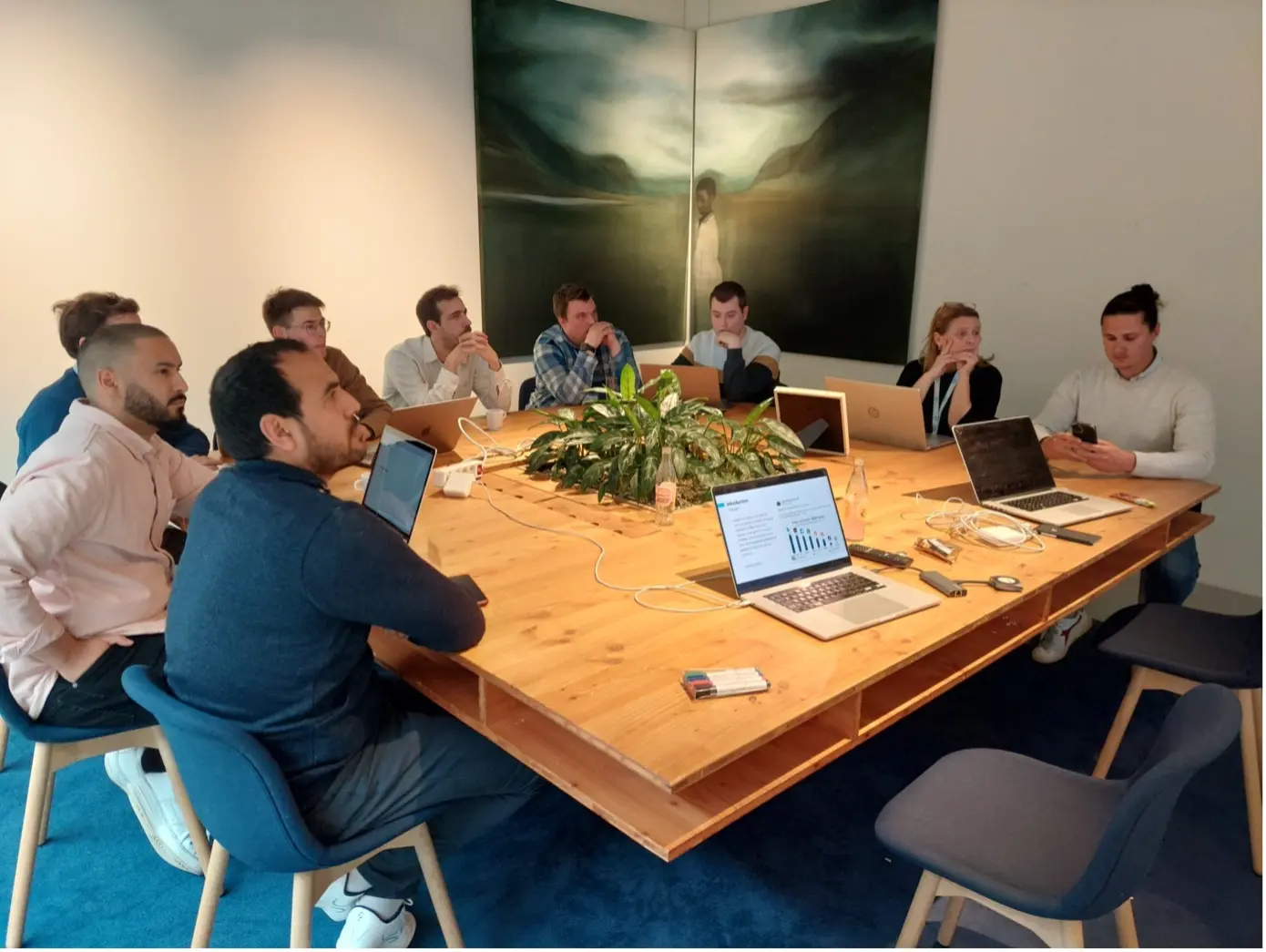
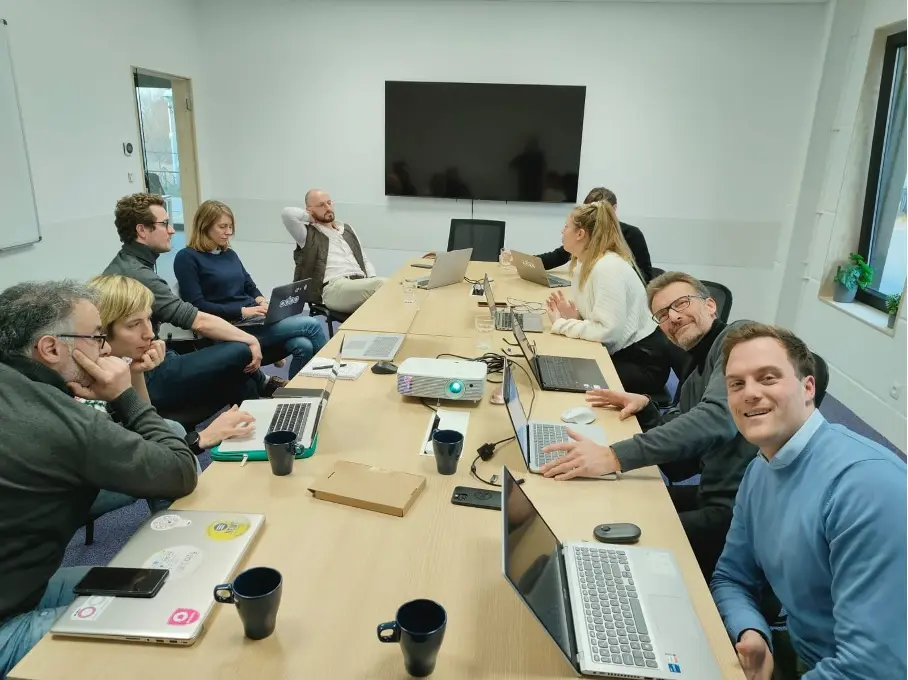
At Eezee, we take an immersive and pragmatic approach.
Our team visits your premises, engages with your key users, and analyzes your existing tools to fully understand how your company operates.
This deep dive allows us to identify challenges, detect inefficiencies, and co-create a tailored ERP setup using Odoo—one that simplifies your processes and accelerates your growth.
How do we structure your ERP project for smooth implementation?
Before starting any ERP implementation, it’s crucial to lay a solid foundation. At Eezee, we break down each project into structured steps to ensure a seamless and surprise-free integration. Our method combines business process analysis, optimization, and technical validation to design a solution truly aligned with your operational needs.
We begin by getting a deep understanding of your organization: workflows, tools, and pain points. From there, we assess how best to integrate Odoo, factoring in your data, expectations, and constraints. Once the vision is clear, we validate it through concrete tests and define a detailed, budgeted action plan that provides you with a clear roadmap.
When is a Solution Design phase essential in your ERP project?
Although Odoo offers a powerful set of features out of the box, launching a project without first aligning it with your business context can lead to costly mistakes.
The Solution Design phase is key to defining the right foundation and ensuring a smooth, efficient implementation.
Solution Design is especially recommended when:
- You want to optimize your business processes by identifying and simplifying time-consuming tasks to boost operational efficiency.
- You’re discovering Odoo and need guidance on how it fits your organization.
- You’re migrating from an existing ERP (SAP, Microsoft Dynamics, Sage…) and want to ensure a smooth transition.
- You want to secure your implementation with a structured, budgeted, and risk-aware plan.
What methodology do we use to design your Odoo ERP?
Forget generic rollouts. We build your ERP on what really matters: your workflows, your goals, and your business logic. Our structured 6-step method turns complexity into clarity — so you can move fast, stay in control, and get results.
Business-first. Value-driven. Built for impact.

1Immersion & preliminary analysis
We immerse ourselves in your daily operations, meet your teams, and analyze your current processes to spot friction points and define clear priorities.
Before any ERP implementation, it’s essential to fully understand your organization and how it operates. We immerse ourselves in your business to analyze your current workflows, strategic goals, and the challenges your teams are facing.
Our consultants visit your site, observe day-to-day operations, and run collaborative workshops with key users. These exchanges help us gather expectations, identify efficiency gains, and detect existing blockers. We also analyze how your departments and tools interact to uncover opportunities for process improvement.
At the same time, we work with you to define the project scope.
This step clarifies the functionalities to be implemented, the workflows to optimize, and the priorities to address. By aligning on scope from the start, we ensure a focused and controlled implementation tailored to your actual needs.
Key deliverables:
- Mapping of existing processes (as-is)
- Definition of the project scope and key objectives
- Identification of pain points, challenges, and improvement opportunities
2Tools & data assessment
We audit your IT ecosystem to evaluate which tools can be integrated, replaced, or optimized for a smoother Odoo transition.
To build a robust ERP system, it’s crucial to evaluate your current IT environment. We conduct a comprehensive audit of your tools and data to understand how they support—or hinder—your business operations.
Our team reviews your software ecosystem to identify which tools can be replaced, integrated, or simplified with Odoo. We analyze interactions between systems and assess opportunities for streamlining workflows. In parallel, we evaluate your data quality to ensure clean migration and proper structuring of master data.
This assessment helps define the best integration approach, eliminate redundancies, and build a future-proof architecture that supports your growth.
Key deliverables:
- Inventory and analysis of your existing tools
- Identification of tools to integrate, replace, or phase out
- Assessment of data quality and recommendations for migration
3Target solution design
We design your future ERP setup by defining optimized business flows, selecting the right modules, and identifying needed customizations.
Once your processes and tools have been analyzed, we design your future ERP setup with a pragmatic, results-oriented mindset.
The goal is to create a solution that fits naturally into your organization, improves efficiency, and drives adoption.
We define optimized business flows by simplifying and automating tasks where relevant. Our approach balances customization with Odoo standards to reduce technical debt and ensure long-term maintainability.
Using BPMN diagrams and process maps, we provide a clear, shared vision of how your future system will function. We also define the functional scope: selecting the Odoo modules that best support your needs, identifying the custom developments required when the standard doesn't go far enough, and specifying any necessary integrations with your existing tools.
This phase ensures your project is aligned with both business expectations and technical feasibility.
Key deliverables:
- Optimized business process models
- Functional scope
- Identified customizations and integrations
4Validating key processes with a Proof of Concept
We translate your business needs into concrete functionalities, and technical specifications when needed, to design a future-proof ERP setup.
Before launching the full implementation, we may validate your future ERP setup through a Proof of Concept (POC), when relevant. This stage allows us to test key workflows, reduce uncertainties, and involve your teams early in the process.
We configure a test environment in Odoo using either real or sample data, so your key users can explore the solution and experience how it will work in practice. This hands-on phase helps fine-tune configurations, confirm critical decisions, and collect valuable feedback.
The POC focuses on the most strategic aspects of your business such as inventory, invoicing, or sales — and may also include specific developments or integrations. This ensures your final ERP setup is relevant, tested, and ready to deliver real value from day one.
Key deliverables:
- Operational Odoo test environment
- Validated core processes
- Identified adjustments before full deployment
5Deliverables & planning
We consolidate your priorities, define a phased roadmap, and validate the budget to secure a smooth and predictable implementation.
Once the solution is validated, we consolidate everything into a clear and actionable plan.
This step secures your ERP implementation by providing full visibility on priorities, workload, and expected outcomes.
We structure a comprehensive backlog covering all necessary tasks, grouped by functional domains and estimated in terms of effort. The project is then broken down into logical phases based on business value and technical dependencies.
To minimize risks and avoid scope creep, we validate the roadmap and budget with you before moving forward. This ensures that expectations, costs, and priorities are fully aligned.
When needed, we also prepare a formal specification document for more complex developments. Finally, we define a deployment roadmap with key milestones and resource planning to keep the project on track.
Key deliverables:
- Structured backlog with prioritization and effort estimates
- Implementation roadmap with milestones and phases
- Optional specification document
- Budget and risk alignment for controlled execution
Our commitments for structured, value-driven ERP projects
Each Solution Design we deliver is crafted to bring measurable value to your business. We focus on aligning your ERP with your operations, streamlining processes, and setting the stage for long-term success with clarity, control, and performance from day one.


Why choose Eezee for your Solution Design ?
At Eezee, we don't just deploy Odoo — we co-design a solution that fits your business reality and drives operational excellence. Our team takes the time to understand your processes, your tools, and your challenges to build a system that brings value from day one. No unnecessary complexity, just the right setup to help your business grow with confidence.
With Eezee, you benefit from:
- A full immersion into your business reality. We meet your teams, observe how you work, and analyze your processes in depth to design a solution truly aligned with your operations.
- A strategic vision beyond the ERP. We don’t just install Odoo — we design a smart information system where every tool serves your business goals, with seamless integrations.
- A pragmatic and ROI-focused approach. We eliminate unnecessary complexity, reduce development overhead, and prioritize solutions that deliver measurable impact.
- A structured and phased methodology. We break down your project into clear steps, aligned with business priorities and validated along the way : no surprises, just results.
- End-to-end support from day one. From analysis to implementation, our team stays involved to ensure continuity, smooth handovers, and consistent guidance throughout the project.
- Proven expertise with 250+ ERP projects. With over a decade of experience, we know how to turn complexity into clarity — including advanced omnichannel, migration, and integration challenges.
Let’s turn your ERP project into a real business accelerator.
Contact usFrequently asked questions (FAQ)
Odoo ERP for Manufacturing : from shop floor to business performance.
Odoo MRP (Manufacturing Resource Planning) centralizes production orders, bills of materials, work centers, routings and procurement into a single system. It provides the operational foundation for reliable planning, reduced lead times and better resource utilization, replacing the fragmented combination of spreadsheets, standalone planning tools and disconnected ERP modules that most growing manufacturers struggle with.
See our article on Odoo MRP : how to plan your production efficiently
Yes. Odoo supports multi-level BOMs, phantom BOMs, configurable variants and dynamic product code generation. At Xeryon, Eezee enabled the management of over 100,000 product configurations within a single Odoo instance with full manufacturing traceability maintained across all variants.
The Odoo Shop Floor module gives operators real-time access to production orders, work instructions, time tracking and quality checks from any device. It does not require a full Odoo licence per operator, making it significantly more cost-effective than traditional ERP models for production environments with large operator teams.
Odoo integrates quality checkpoints at every stage of the production process incoming materials, work-in-progress and finished goods. Full lot and serial number traceability is available in both directions: forward to customer delivery, backward to supplier batch. This is critical for regulated industries including food, pharma and medical devices.
See our article on traceability in manufacturing with Odoo : lots, serial numbers and compliance
Yes. With properly structured analytical accounting, Odoo provides real-time visibility on actual vs standard costs per production order, including labour, materials, overhead and rework. This is one of the most impactful capabilities Eezee implements and one of the most underused in standard Odoo deployments.
See our article on how to calculate the real profitability of your production orders
Yes. Odoo's quality, traceability and document management capabilities support compliance with major regulatory frameworks. Configuration depends on the specific requirements of your industry and certification body. Eezee has experience implementing Odoo in food, biotech, chemical and industrial component manufacturing environments with regulatory constraints.
Yes. One of Odoo's key strengths is the native integration between manufacturing, inventory, sales, B2B portals, e-commerce and field service within a single database. This is particularly relevant for manufacturers who also distribute directly or manage after-sales service operations.
Odoo's evolving AI capabilities enable smarter forecasting, intelligent scheduling, predictive procurement and anomaly detection on production KPIs. For manufacturers with the right operational data foundation, AI agents can automate routine decisions and surface insights that previously required hours of manual analysis. Eezee advises on where AI creates genuine value in your specific manufacturing context and how to activate it progressively.
Implementation timelines vary depending on scope, product complexity and organizational maturity. Most manufacturing projects at Eezee are delivered within 3 to 8 months, with a phased approach that prioritizes core production flows first and extends progressively to advanced analytics, additional modules or integrations.
Because we don't just implement Odoo, we build a unified manufacturing model. We master the specific challenges of industrial operations: multi-BOM complexity, shop floor adoption, analytical cost tracking, quality integration and bidirectional traceability. We are an international Odoo Gold Partner with proven references across custom machine building, process manufacturing, multi-site operations and regulated environments.